Flying with a car seat, from the kerb to the carousel
Four decisions get made between a car park and a boarding gate, and only one of them is about the bag. Here is what the federal guidance actually says, and where a padded body genuinely helps.
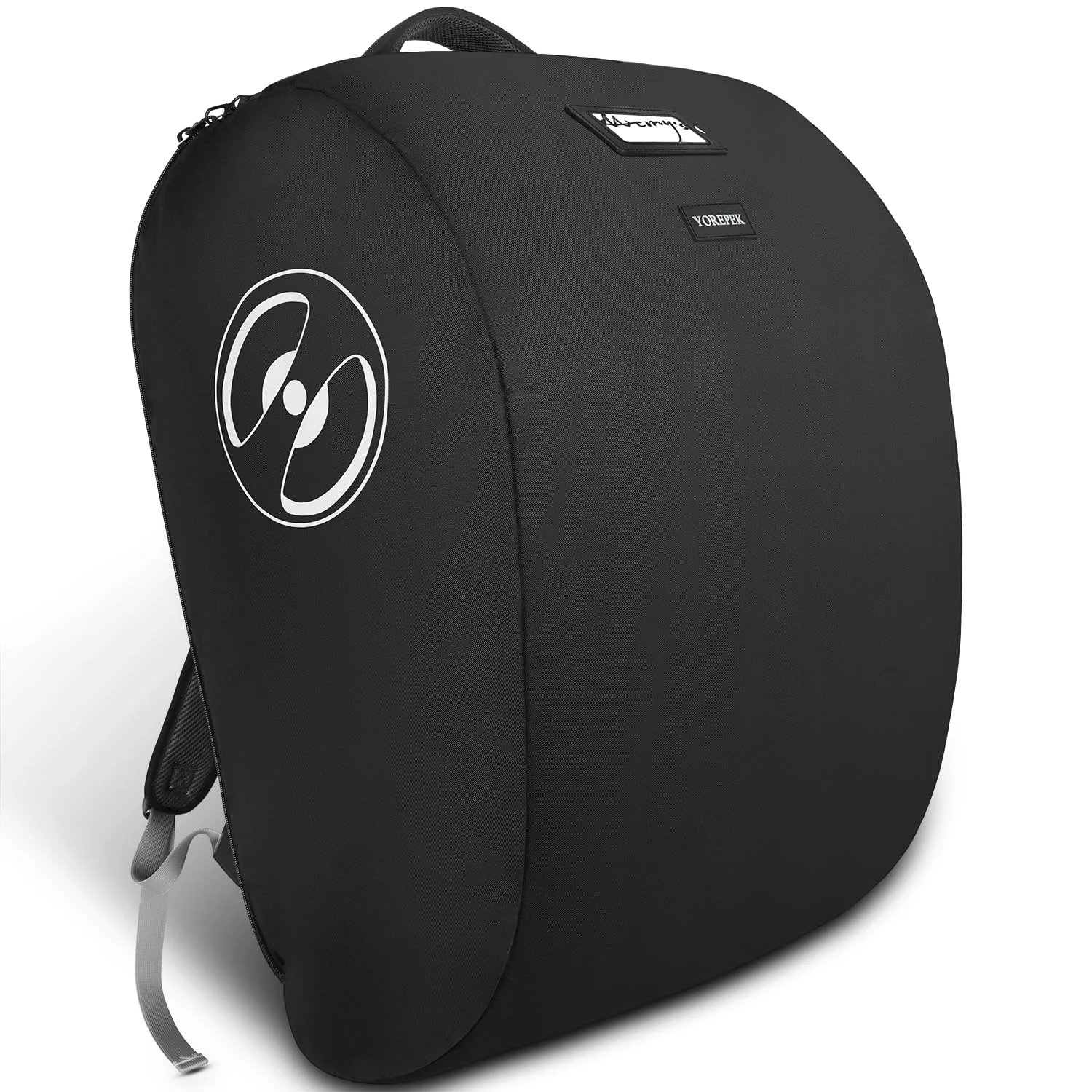
You are standing at a kerb with a car seat in one hand, a child on the other hip, and a decision you have been putting off since you booked. Does the seat come into the cabin, or does it go under the plane? Nobody at the airport is going to make that call for you, and the answer changes what you need to do for the next three hours.
The decision itself is not really about luggage. It is about where your child sits during the flight, and on that the federal aviation administration has been unambiguous for years.
First: does the seat come with you into the cabin?
The FAA's own words are worth reading before anything else: the safest place for a child under the age of two on a US airplane is in an approved child restraint system or device, not in your lap. They go further and say the agency strongly discourages carrying a lap child at all, and that buying a ticket for your child is the only way to guarantee you will be able to use a seat for a child under two.
The safest place for your child under the age of two on a U.S. airplane is in approved child restraint system (CRS) or device, not in your lap.
That is the recommendation. It is not a regulation, and airlines will let you fly with a child under two on your lap. And it is why the bag is the last decision rather than the first: if the seat is going into the cabin, the thing to check is the label on its shell, not the luggage around it.
The label is the whole check
A car seat going into an aircraft seat has to be certified for it, and the certification is printed on the shell. The FAA asks you to confirm the seat carries the line “This restraint is certified for use in motor vehicles and aircraft”, or, if it was approved by a foreign government, the marking that government requires.
Two things follow from that. The first is that a seat without the line does not go into a cabin seat, whatever anybody at the gate says. The second is quieter and catches people out: the FAA also asks you to read the manual and confirm your seat can be secured properly in an airplane seat, because if it cannot, you may be asked to check it as baggage instead. That is a decision being made for you at the door of the aircraft, and it is a much better one to have anticipated.
The strap-based alternative, and what it is not
There is a second approved route, and it is worth knowing because it weighs almost nothing. The CARES device is a harness that works with the existing aircraft seatbelt, certified for children between 22 and 44 pounds and up to 40 inches tall, approved for taxi, take-off, landing and turbulence.
It is also approved for aircraft only. It is not a car seat, it does nothing in a vehicle, and if you take it instead of a seat you will need a seat at the other end. For a family flying to grandparents who already own one, that is a good trade. For a family renting a car at the far end, it is half a solution.
So the seat is going under the plane. Now the bag matters
This is where a bag stops being optional and starts being the difference between a seat you install at the far end and a seat you look at doubtfully.
A checked or gate-checked car seat is handled like luggage, because that is what it now is. It rides a belt, sits on an apron in whatever weather there is, and has other bags stacked against it in a hold. None of that is dramatic. All of it leaves marks on a shell.
The reason marks matter is not cosmetic, and it is the one thing here worth carrying to the airport in your head. The national highway traffic safety administration sets out when a car seat may keep being used after a crash, and its list of conditions for a crash minor enough to keep the seat ends with a plain one: there is no visible damage to the car seat.
That sentence is about crashes rather than baggage handlers. But it tells you what the people who write this guidance think matters about a shell, and it hands you the right habit at the carousel: open the bag, look the seat over, and install it only once you have. A bag keeps grease and rain off a shell and gives a handler something to hold. It does not certify what is inside it, and no bag on any website can.
Sizing the bag: measure the seat, not the child
Every question about which bag ends here, and two minutes with a tape measure answers it.
- Measure the shell at its widest point, usually across the shoulder wings.
- Measure it at its tallest, with the headrest at the height it will travel in.
- If the base is travelling, measure the seat and base together, sitting as they will sit.
- Add nothing for luck. Then take the bag body that clears those numbers.
| Body | What it takes | Where it stops |
|---|---|---|
| 22 x 19 x 15 in | An infant carrier on its own, handle up | A convertible seat will not go in |
| 28 x 17 x 17 in | Most infant seats and a compact convertible | A tall convertible that does not fold |
| 29.1 x 18.1 x 17.7 in | A Doona with its isofix base | Anything wider at the shoulders |
| 31.5 x 18.5 x 17 in | A tall convertible that will not fold down | A seat travelling with a separate base |
| 28 x 18 x 18 in, wheeled | The same load, towed rather than carried | Folding down small for the return trip |
The mistake people make is measuring the child. A four-month-old and a three-year-old can be in the same shell, and a bag has never once cared how old anybody is.
Gate check or desk check
Both are the airline's policy rather than anybody else's, and most US carriers take a child restraint free of charge either way. The practical differences are worth thinking about before you are in the queue.
Desk check means the seat disappears at the start and comes back at the carousel. You walk through the airport unencumbered, which with a toddler is not nothing, and the seat spends the longest possible time in the system.
Gate check means you keep the seat to the aircraft door and collect it on the jet bridge or at the carousel, depending on the airport. It spends less time being handled. It also means you carry it through security, which is the argument for backpack straps: the two hands you have at a checkpoint are usually already holding a child and a boarding pass.
What to put in the bag besides the seat
Almost everybody discovers this on the second trip. A car seat bag is mostly air once the seat is in it, and soft things in that air are doing two jobs at once: they pad the shell and they travel free.
Nappies, wipes, a blanket, the following week's laundry on the way home. What does not go in is anything you will want before the carousel, anything hard enough to press on the shell, and anything you would mind losing, because a checked bag is a checked bag whatever is written on the outside of it.
At the far end
Three minutes, in this order, and then you are done.
- Take the seat out of the bag before you leave the terminal, in the light.
- Look over the shell, the belt path, the harness webbing and the buckle. Cracks, deep gouges and anything that has changed shape are the things you are looking for.
- Check the manual for how this seat installs with a lap belt, because a rental car may not have the anchors your own car has.
- Fold the bag into the boot. On the wheeled bodies this is easier than it sounds; on the foldable one it is the whole point.
None of this takes long, and all of it is easier than the alternative, which is finding out at the roadside that the seat has a crack in the shoulder wing you did not look for at the airport.
The short version
If your child is under two, the FAA would rather they were in an approved seat in their own seat than on your lap, and the label on the shell is what decides whether that is possible. If the seat is going under the plane instead, the bag is luggage: it keeps the shell clean, gives a handler a handle, and buys you the ability to look the seat over at the far end and know that what you are seeing is the seat rather than the journey.
Every figure in this piece comes from the sources listed below, read on the date shown. Nothing in it is our own testing, because we have not done any, and a page that pretends otherwise is not worth the tape measure.
One button, the whole Yorepek range
Every size, colour and capacity in the Yorepek catalogue sits behind this button, with the price from our last update beside it. Measure the thing you have to carry, check it against the dimensions on the card, and it ships from our retail partner.