Why a 96-bottle nail case holds 71 of your bottles
Slot counts are honest and still misleading, because they are measured on one bottle shape. Here is how to work out your own number in five minutes, and what the rules are if the case has to fly.
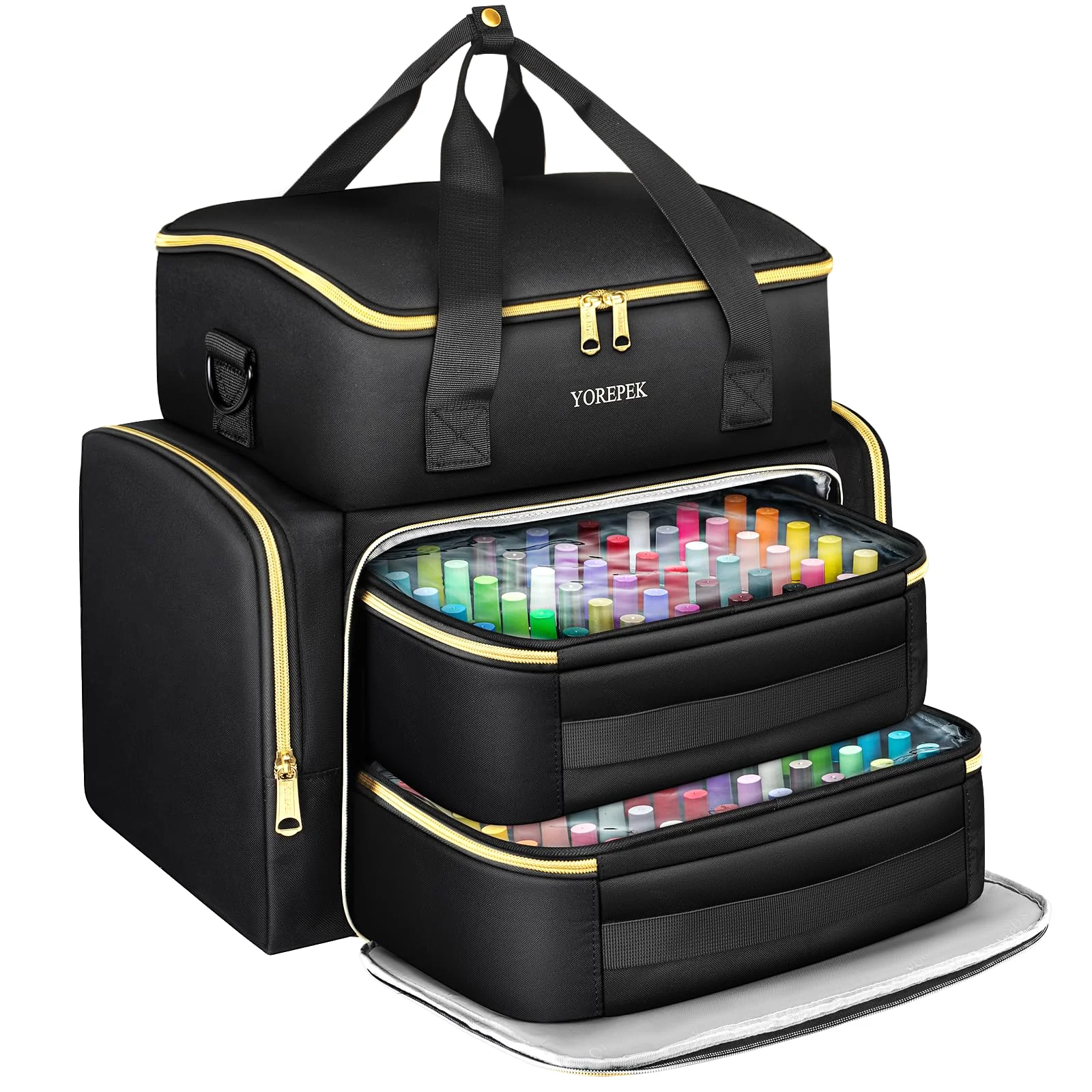
A case that says 96 bottles will hold 96 bottles. It will hold 96 of one particular bottle, and the gap between that bottle and yours is why people buy a second case within a year.
This is not a trick and nobody is lying. It is a measurement problem, and it takes five minutes and one bottle from your own collection to solve.
What a slot is cut for
The standard bottle these cases are built around is 15 ml — half a fluid ounce — with a round base. That is the bottle most mass-market polish comes in, and a foam or fabric slot cut for it holds it snugly enough that the case can be tipped without anything rattling.
Snug is the operative word. A slot loose enough to take any bottle is a slot that holds no bottle, and the tightness that makes the case work is the same tightness that makes it fussy about shape.
The four ways your bottles are different
| The difference | What happens | Cost in slots |
|---|---|---|
| A square or hexagonal base | The corners bind on the cutout | One bottle, one or two slots |
| A wide-shouldered gel bottle | It goes in, but the neighbours will not | Roughly one and a half |
| A tall bottle or a long brush cap | It stands proud and the tray above will not close | The whole layer |
| A 0.6 oz or larger bottle | It does not go in at all | Lives outside the case |
One owner of the 96-bottle body put the first row exactly: she likes a brand whose bottles are not round and are not particularly small, and they barely fit into the cutouts in the foam. She squeezed them in, and then wrote down the thing worth repeating — that over time she expects the foam to wear from the strain.
The bottles sure aren’t round. Nor are they particularly small. They barely fit into the cutouts in the foam pad provided.
Your own number, in five minutes
- Take one bottle of each shape you own and stand them on a table.
- Measure the widest one across its base, and measure the tallest one to the top of the cap.
- Count what fraction of your collection is the standard round 15 ml shape. That fraction of the slot count is what you will genuinely fill.
- Anything taller than the tray depth is not a slot problem, it is a lid problem: it goes in the open section instead.
- Add the things that are not bottles at all — a lamp, files, drill bits, a top coat you never move — because they need the open compartment, not the trays.
Run that on a typical mixed collection and 96 slots usually turns into somewhere in the seventies of genuinely filled ones. That is not a bad result; it is the right expectation to have before you order, and it is the reason the honest advice is to size up rather than to match the count.
The bodies, and what the jump between them costs
The counts on this catalogue run 48, 56, 70, 72, 96 and 100-plus, and the physical difference between the ends is smaller than the numbers suggest.
| Count | Body | Where it lives |
|---|---|---|
| 42–48 bottles | 11 x 9 x 7 in | On a shelf, not in storage |
| 56–72 bottles | 12.6 x 11.4 x 7.9 in | A drawer or a cupboard shelf |
| 96–100+ bottles | 15 x 14 x 9.5 in | A cupboard floor or a car boot |
| 96+ with straps | 17 x 16.5 x 9.5 in | Two shoulders, house calls |
The jump from 72 to 96 costs about three inches of length and an inch of depth. That is worth knowing if the case has to fit a particular drawer, and it is the reason to measure the space before the collection.
The trays, and why they pull out
The layers in these cases are trays rather than pockets, and that changes how the thing is used more than any capacity figure does.
A full case opens without anything having to be lifted over anything else. A tray you are not using today can come out and stay on a shelf. On the bodies with straps, that is the whole argument: a job that needs forty bottles does not have to carry a hundred across a car park.
The other consequence is less obvious. Because the layers are independent, a case bought for polish gets used for other things — and does, constantly. One owner keeps mica powder and small resin bottles in hers. Another does not use it for polish at all and travels with hair kit, makeup and her husband's shaving kit in it.
Flying with it full
This is a rules question rather than a capacity one, and the rules are short.
In a carry-on, nail polish is a liquid like any other and falls under the 3.4 ounce (100 ml) limit. Since a standard bottle is 15 ml, that is rarely the constraint people expect — the constraint is the total volume of liquids you are carrying, and a hundred bottles of 15 ml is 1.5 litres of liquid.
In checked baggage the FAA caps the aggregate of restricted toiletry articles at 2 kg or 2 L per person, with no single container over 0.5 kg or 500 ml. And on both sides of that, TSA is explicit that the final decision rests with the officer at the checkpoint.
- A hundred 15 ml bottles is about 1.5 L — inside the checked aggregate, but not by much
- Carry-on: each bottle is under 100 ml, and the liquids allowance is the real limit
- A professional kit crossing a border is a customs question as well, and that is beyond anything printed here
The practical version: a case that holds a hundred bottles is a case that holds a hundred bottles at home. What travels is a tray of them, which is the argument for the removable layers all over again.
Two things people wish they had known
The first is the foam. A slot forced open by a bottle it was not cut for stays open, and the bottle after it rattles. If a shape does not fit, the honest move is to keep those bottles in the open compartment rather than to make them fit.
The second is the hard base. The larger bodies have a stiffened bottom, and it is doing more work than it looks like — a case with a hundred bottles in it is heavy, and a soft base lets the whole thing sag and the trays bind. If you are choosing between two bodies of the same count, the one that stands up empty is the one to take.
The short version
Measure one bottle before you read any capacity figure. Expect the round-15 ml fraction of your collection to be the number you actually fill, size up rather than match, and put the odd shapes in the open compartment instead of forcing a slot. If it has to fly, the rules are the liquids rules and the officer decides — and the tray that comes out is the part that travels.
One button, the whole Yorepek range
Every size, colour and capacity in Yorepek essentials sits behind this button, with the price from our last update beside it. Measure the thing you have to carry, check it against the dimensions on the card, and it ships from our retail partner.