What actually goes in a 17-inch travel backpack
Three compartments, ten-plus pockets and four days of clothes, laid out item by item with the volume each one really takes. Includes the two things that never fit and why.
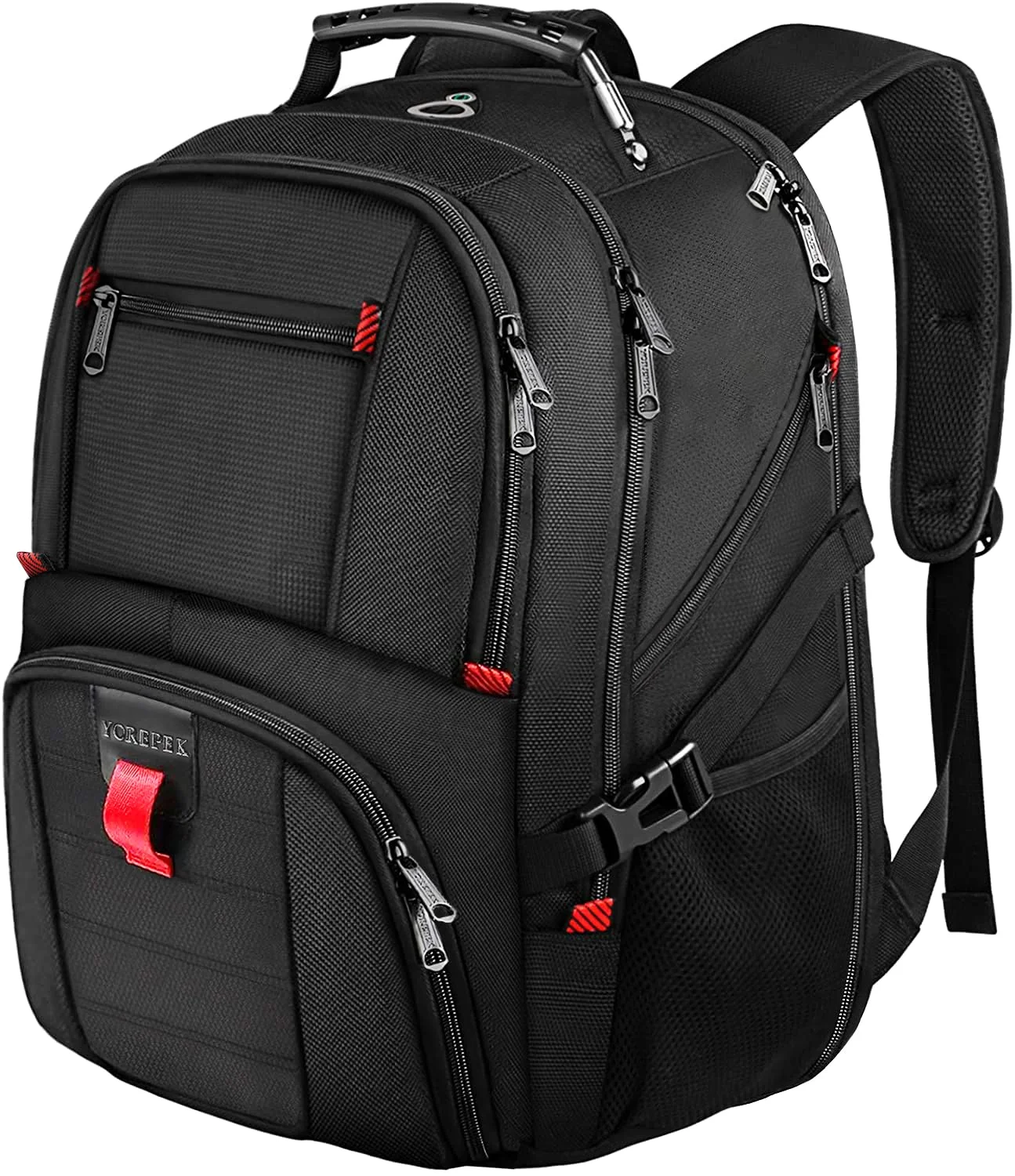
There is a moment on the night before a trip when a bag stops being a bag and becomes an argument. Everything is on the bed. Everything, individually, is reasonable. Together it is a suitcase.
This is a packing list for a specific object: a 17.5 by 13 by 8.5 inch travel pack with a padded sleeve cut for a seventeen-inch laptop, three compartments and something over ten pockets. The numbers below are what actually goes into one for three or four days away, and where each thing lives.
The number that decides everything: seventeen inches
Start here, because if this number is wrong nothing else in the list matters.
A seventeen-inch machine does not go in a fifteen-inch sleeve. Not tightly, not diagonally, not if you take the case off. What happens instead is that the laptop ends up in the main compartment lying against a hoodie, or in a second bag on your other shoulder, and you have spent money on a backpack while still carrying two things.
Measure your screen corner to corner. If it is fifteen or sixteen, this sleeve holds it with room to spare and you can stop worrying. If it is an eighteen-inch gaming machine, this is the wrong sleeve and the wider bodies on the same shelf are the right ones.
Compartment one, against your back: the machine
The sleeve rides closest to your spine, and that is not decoration. A heavy flat object held against the back is a load your hips can carry; the same object out at the front of a bag is a lever pulling on your shoulders. It is the same reason paediatric guidance on school bags asks for the heaviest items closest to the body.
What goes in with it: the laptop, a tablet if you carry one, and paper. Nothing with a corner. A charger block in this compartment presses into the machine every time you sit the bag down.
Compartment two, the middle: the trip
This is where three or four days live, and it holds more than it looks like it will if you roll rather than fold. A worked list for four days in reasonable weather:
- Four t-shirts or three shirts, rolled — about the volume of a loaf of bread
- One pair of trousers or jeans in addition to the pair you travel in
- Four sets of underwear and socks, in the gap along the hinge where nothing else fits
- A jumper or a light fleece, which is the single bulkiest thing you will carry
- A pair of shoes, if they are soft — trainers go in, boots do not
- A washbag, which lives on top because it is the first thing out
That is the compartment full, and it is genuinely four days. What does not go in it is the coat: a coat is worn, carried over an arm, or left at home, and any packing list that puts a winter coat inside a carry-on is a list written by somebody who has not tried.
Compartment three, the front panel: the small awkward things
The front panel is the one with the pen loops, the key clip and the pockets, and it is the compartment that decides whether you enjoy the bag or merely own it.
Chargers and cables. Passport and boarding pass. Headphones. A pen that works. Medication. A power bank, which on this body has a routing hole to the outside USB port — worth saying plainly that the port is a passthrough and there is no battery in the bag, because people do occasionally expect one.
The reason this compartment matters more than its volume suggests is that everything in it is something you need while standing up, in a queue, with one hand. A bag where those things are at the bottom of the main compartment is a bag you unpack on the floor at security.
The checkpoint, and why the lid opens flat
TSA's rule on laptops is short: they travel in carry-on and checked bags alike, and outside PreCheck you take the laptop out of the bag and put it in a separate bin for X-ray. With PreCheck it stays in.
That is the whole reason an opening angle is a feature. A pack whose lid lays out flat puts the sleeve face-up in the tray with the machine still inside it — which is what a screener wants to see — instead of you standing over a bin holding a laptop in one hand and a bag in the other while the queue backs up behind you.
The two things that never fit
Both of these get attempted, and both fail for the same reason.
A pair of hard shoes. Dress shoes, boots, anything with a rigid sole and a heel: they do not compress, they do not share space, and two of them take a third of the middle compartment. If you need them at the far end, wear them and pack the trainers.
A week. This is a three-to-four day bag with a laptop in it, and no packing technique changes that. People who fly for a week with one of these are either doing laundry at the far end or not carrying a seventeen-inch machine, and both are fine — but the arithmetic is the arithmetic.
Weight, honestly
The bag will hold more than your back wants to. That is true of every well-designed pack and it is worth saying out loud, because volume is not the constraint people meet in an airport; a shoulder at the end of a long terminal is.
An independent test of the fifty-litre version of this pack made the same point from the other direction: nine out of ten for storage, and then a note that once it is loaded to its maximum it stops being comfortable. That is not a fault so much as a fact about carrying things, and the practical answer is to pack the bag you will be carrying rather than the bag you own.
| Item | Compartment | Notes |
|---|---|---|
| 17-inch laptop | Back sleeve | The reason for the bag; nothing sharp beside it |
| Tablet, paper | Back sleeve | Flat things only |
| Four days of clothes, rolled | Middle | Rolled, not folded; the jumper is the bulky one |
| Soft shoes | Middle, at the base | Hard shoes are worn, not packed |
| Washbag | Middle, on top | First out at the far end |
| Chargers, cables, power bank | Front panel | The USB port is a passthrough, not a battery |
| Passport, pen, headphones | Front panel pockets | Everything you need standing up |
| Water bottle | Side pocket | Outside the bag, where a leak stays outside |
The strap on the back
One small thing that changes airports: the luggage strap on the back panel drops the pack over the handle of a rolling case. If you are travelling with a suitcase as well, that turns two bags into one thing you push, and it is the feature people mention most often once they have used it for a while.
It also means the pack rides at the height of a suitcase handle rather than on your shoulders for the length of a terminal, which is the same problem the independent reviewers ran into from the other end.
The short version
One number decides the bag: the diagonal of your screen. Three compartments decide the packing: machine at your back, trip in the middle, everything you need while standing up in the front. Four days go in comfortably and a week does not. And the lid opens flat because at a checkpoint outside PreCheck the laptop is coming out of the bag whether you planned for it or not.
One button, the whole Yorepek range
Every size, colour and capacity in the Yorepek selection sits behind this button, with the price from our last update beside it. Measure the thing you have to carry, check it against the dimensions on the card, and it ships from our retail partner.